It’s always exciting when your salary lands in your bank account. I know I’m always ready to plan out my month ahead! But have you ever stopped to think about the portion of your salary that doesn’t show up in your account? You know, the part that goes to taxes?
Most people in Sweden assume they pay around 30% in taxes. While that number might sound about right, the actual amount you pay is often very different. This article will help you understand what really happens on your Swedish payslip, so you can make sense of your income, deductions, and taxes.
To make this easier, let’s get some help from Bamse, a familiar name if you’ve been following mykronor.
Bamse lives in Huddinge, Stockholm, and works as a security officer. He earns the median income of 37,100 SEK per month. Let’s look at what happens to his salary and break down all the taxes and fees step by step.
1. Basic Deduction (Grundavdrag)
Bamse’s taxable income isn’t actually 37,100 SEK. He gets a basic deduction of 1,592 SEK, which means his taxes are calculated on 37,100 – 1,592 = 35,508 SEK.
The amount of your basic deduction depends on your total income. It’s higher for lower incomes and decreases as your income rises. Learn more at Ekonomifakta – Grundavdraget.
2. Municipal Tax (Kommunalskatt)
Municipal tax varies based on where you live in Sweden. The highest tax is in Degerfors kommun (35.3%) while the lowest is in Österåkers kommun (28.98%).
In Huddinge, Bamse pays 31.84% in municipal tax. That’s 31.84% of 35,508 SEK = 11,309 SEK in tax.
3. Burial Fee (Begravningsavgift)
This is a small fee that helps maintain cemeteries and covers burial services in Sweden. The rate varies by municipality.
In Huddinge, the burial fee is 0.293%, which equals 104 SEK per month. See your local rate at Skatteverket – Begravningsavgift.
4. Public Service Fee (Public Serviceavgift)
This fee funds Sweden’s state-run media — SVT, Swedish Radio, and Swedish Educational Radio.
It’s 1% of your annual income, up to a maximum of 1,249 SEK for 2025. The limit is adjusted every year.
For Bamse, this works out to about 104 SEK per month. Learn more at Skatteverket – Public Serviceavgift.
5. Earned Income Tax Credit (Jobbskatteavdrag)
As the name suggests, this is a tax credit designed to encourage work. You only get it if you earn income from some form of employment.
The credit increases with income up to a maximum of 3,942 SEK per month.
Bamse receives 3,668 SEK in earned income tax credit each month. See more at Ekonomifakta – Jobbskatteavdraget.
6. Tax Reduction on Earned Income (Skattereduktion Försvarsinkomst)
At this point, I feel like there are way too many deductions and reductions. I guess that’s the tax code for you. This is a general tax reduction. This too has a ceiling based on your annual income.
For Bamse, this reduction adds up to 125 SEK each month, so not that substantial. Details at Skatteverket – Skattereduktioner.
7. Total Tax on Bamse’s Payslip
Let’s sum everything up:
| Item | SEK |
|---|---|
| Earned income tax credit | +3,668 |
| Tax reduction on earned income | +125 |
| Municipal tax | -11,309 |
| Burial fee | -104 |
| Public service fee | -104 |
| Total tax (net effect) | -7,724 |
Bamse pays 7,724 SEK in taxes each month , 20.8% of his gross salary (7,724 ÷ 37,100).
So, the tax Bamse sees on his payslip is about 21%.
However, these aren’t the only taxes that go to Skatteverket on Bamse’s behalf. They are the most visible since they appear directly on his payslip.
8. Employer’s Tax (Arbetsgivaravgifter)
The total cost to Bamse’s employer isn’t 37,100 SEK, it’s actually 48,257 SEK. Employers in Sweden must pay several additional employer contributions (social fees) to Skatteverket. They can be broken down into seven categories:
| Category | Rate (%) | SEK |
|---|---|---|
| Health insurance premium | 3.55 | 1,261 |
| Parental insurance fee | 2.60 | 923 |
| Old age pension contribution | 10.21 | 3,625 |
| Survivor’s pension contribution | 0.60 | 213 |
| Labor market fee | 2.64 | 937 |
| Workers’ compensation | 0.20 | 71 |
| General payroll tax | 11.62 | 4,126 |
| Total | 31.42% | 11,156 |
So, the total tax paid to Skatteverket each month is:
7,724 SEK (employee’s tax) + 11,156 SEK (employer’s tax) = 18,880 SEK
That’s 39% of the total labor cost!
What Does That Mean?
If the employer didn’t have to pay these additional taxes, the total cost (48,257 SEK) could theoretically go straight to Bamse as salary. But in reality, that’s not how tax systems work, employers almost never raise salaries by the amount of saved tax.
Still, this example shows that Bamse’s effective total tax rate (including what his employer pays) is about 39%, even though he personally sees only around 21% deducted on his payslip.
Where Does Your Tax Money Go?
So, what do you get for all that money? While some of the taxes and fees have specific purposes, most of it just falls in a general tax bucket. In the end what you get depends on what the government decides to spend money on. I’ll use the 2023 expenses to breakdown where Bamse’s 21% goes below.
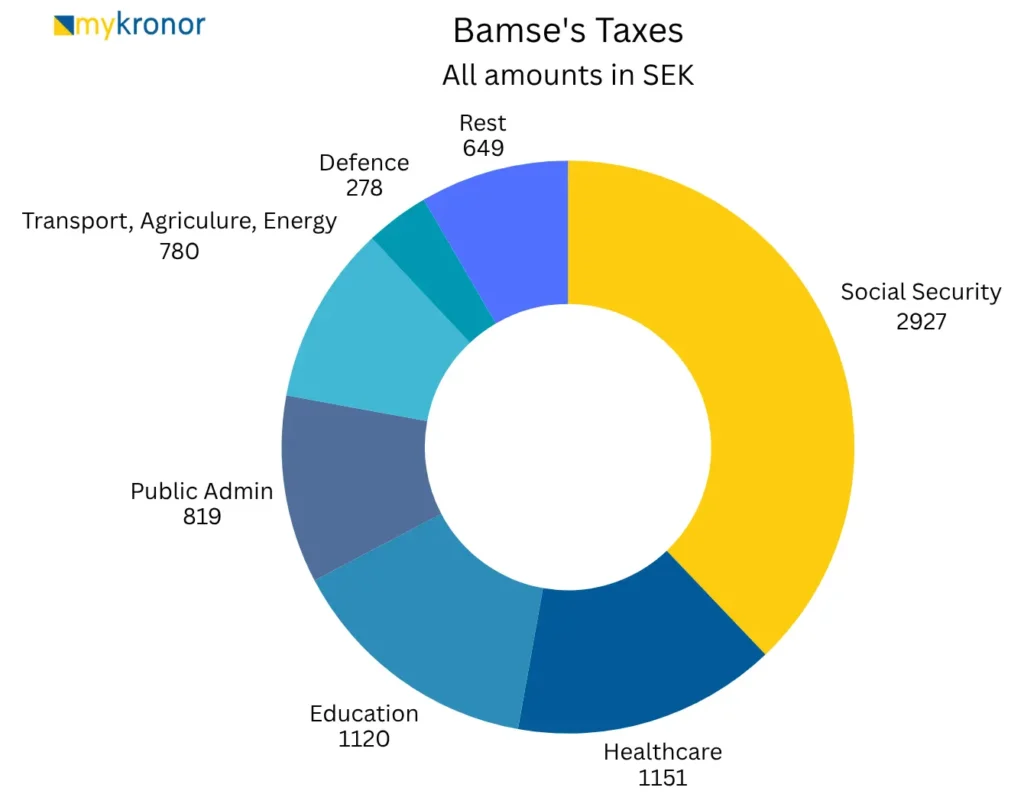
This perspective helps you appreciate what your taxes actually provide and lets you compare high-tax countries like Sweden with lower-tax ones.
Interestingly, while Sweden has high taxes on labor, it has one of the lowest taxes on capital. Did you know Sweden has more billionaires per capita than the United States? Source
That, however, is a story for another time!
What About High-Income Earners?
This article didn’t cover state income tax (high-income tax). It’s an extra 20% tax on income above a certain limit, around 53,600 SEK per month for 2025.
In a future article, we’ll look at how this works and explore the benefits of exchanging salary for pension contributions if you’re a high earner.
Subscribe below to to get notified when it’s published!
Check out my post on pensions to understand where a lot of Social Security taxes end up.
If you’d like to calculate your salary after tax, here is a simple calculator.
